
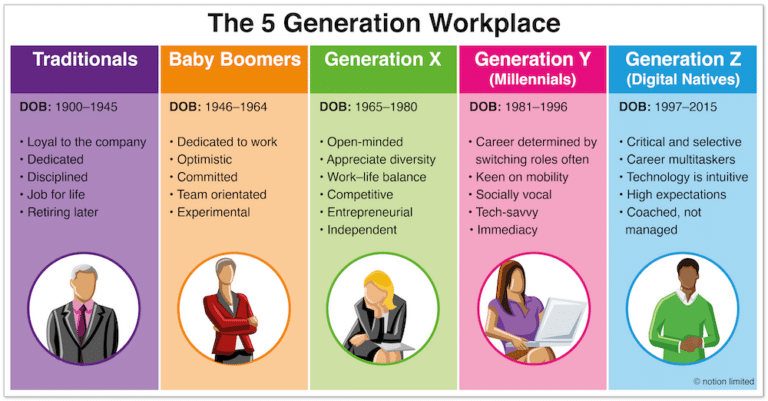
The modern workplace is more age-diverse than ever before. Today, it is possible to find employees from at least five generations working side by side, each bringing different experiences, expectations, and perspectives to the table. While these differences are often viewed as challenges, I believe the real challenge is not age diversity itself, it is whether organizations have developed leaders capable of bringing those generations together.
The Harvard Business Review article Harnessing the Power of Age Diversity (2022) defines a generation as “an age cohort whose members are born during the same period in history and who thus experience significant events and phenomena at similar life stages.” This definition highlights why generations often approach work differently. The technology we grew up with, the economy we entered as young adults, and the social events that shaped our lives all influence how we communicate, collaborate, and lead.
What I find particularly interesting is that generational spans appear to be getting shorter. As technology advances and society changes more rapidly, the experiences that define one generation from another happen more frequently. If that trend continues, organizations will likely find themselves managing even greater generational diversity in the future. Rather than viewing this as a problem to solve, organizations should recognize it as an opportunity to learn from a wider range of experiences and perspectives.
As an adult learner returning to school while continuing to work, I have experienced firsthand how different generations can contribute unique strengths. In my classes, younger students often bring fresh perspectives on technology, social trends, and emerging workplace expectations. Older students frequently contribute practical experience, historical context, and lessons learned through years of professional success and failure. The most productive discussions are not the ones where one generation is right and another is wrong. They are the conversations where different perspectives combine to create a deeper understanding than either group could have achieved alone.
The HBR article recommends conducting an age-diversity audit to better understand how employees experience age-related dynamics within an organization. This is a valuable step, but audits only work if employees feel safe enough to be honest. If people fear judgment, retaliation, or being dismissed, they are unlikely to provide meaningful feedback. Organizations may collect data, but they will miss the truth.
This is where leadership becomes critical.
Throughout my studies in Organizational Psychology, one theme continues to emerge: Employees are more likely to engage in organizational initiatives, share honest feedback, and collaborate across differences when they trust their leaders. Psychological safety, inclusion, and engagement do not happen because a company distributes a survey. They happen because leaders consistently create environments where people feel respected, heard, and valued.
Strong leaders help employees become curious about differences instead of defensive. They encourage knowledge-sharing instead of competition. They focus on common goals rather than generational stereotypes. Most importantly, they create the trust necessary for employees to participate honestly in efforts like age-diversity audits.
As organizations continue to navigate increasingly diverse workforces, the question may not be how to bridge generational gaps. The real question may be whether leaders have created the conditions necessary for those bridges to be built.
How has age diversity impacted your workplace? Have you experienced leaders who successfully brought different generations together, or leaders who unintentionally widened those divides?
Learn More
- Harnessing the Power of Age Diversity (Harvard Business Review)
Explore how organizations can leverage age diversity as a competitive advantage and use age-diversity audits to better understand employee experiences across generations.
- Amy Edmondson’s Research on Psychological Safety
Learn how psychological safety enables employees to speak openly, share ideas, admit mistakes, and provide honest feedback, creating the trust necessary for initiatives such as age-diversity audits and organizational change efforts to succeed.
- Erdogan et al. (2024) on Mentoring and Career Success
Discover how mentoring relationships support employee growth, knowledge sharing, career development, and organizational commitment. Effective mentoring can be particularly valuable in multigenerational workplaces, where employees learn from one another’s diverse experiences and perspectives.
Next on…
In my next post, I will explore what strong leadership actually looks like and why leadership development may be one of the most important investments organizations can make in building inclusive, high-performing workplaces.


Leave a comment